Why PDF Applications Are Dying: Real-Time Financial Data Connections
A broker submits a deal. The client emails over three months of bank statements. Two arrive as PDFs, one as a scanned JPG. The lender’s underwriter asks for tax returns, which come a day later, redacted. By the time the file is complete, the borrower’s revenue has shifted, the AR has turned, and the cash […]
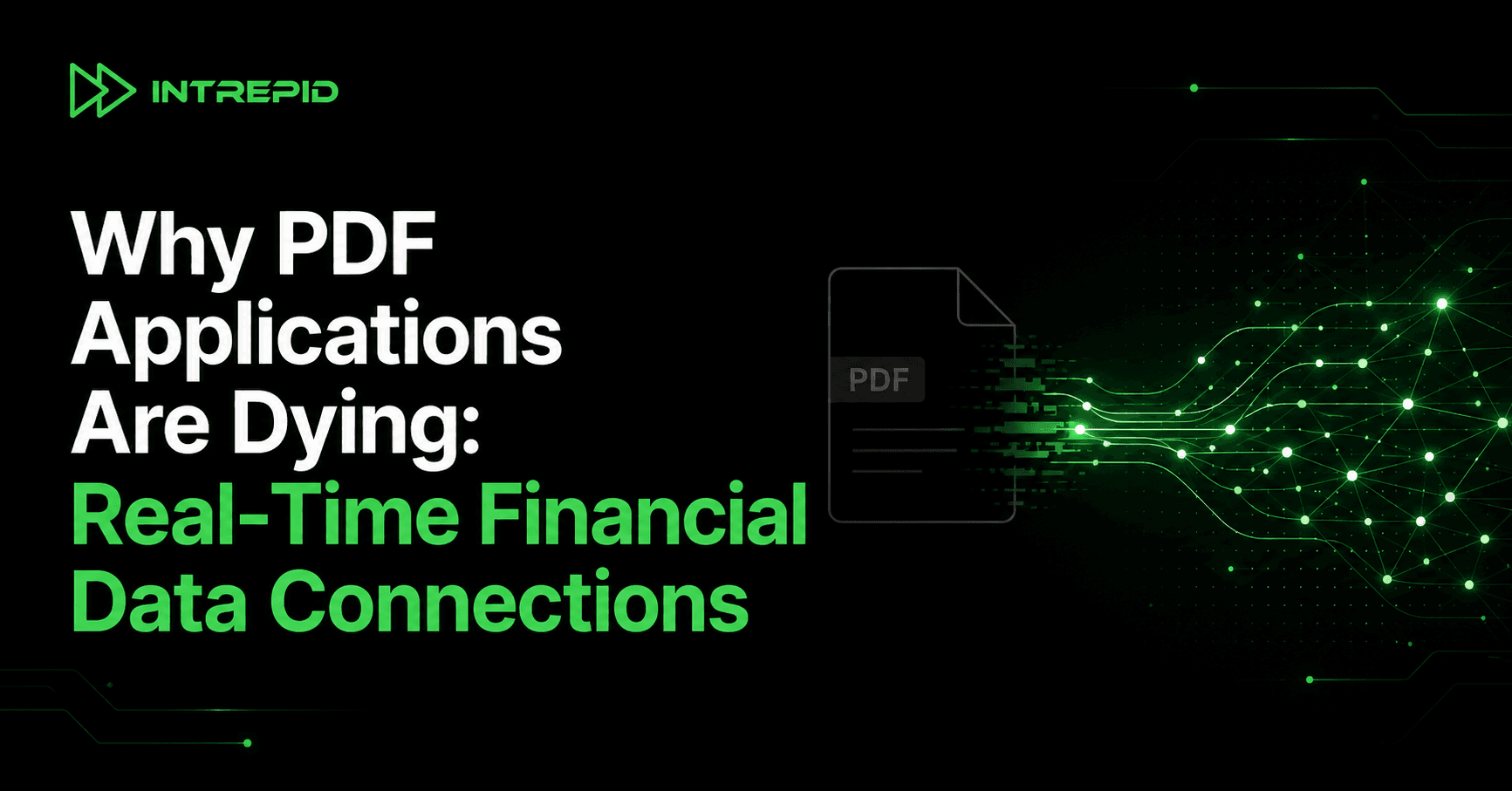
A broker submits a deal. The client emails over three months of bank statements. Two arrive as PDFs, one as a scanned JPG. The lender’s underwriter asks for tax returns, which come a day later, redacted. By the time the file is complete, the borrower’s revenue has shifted, the AR has turned, and the cash position is no longer accurate. This is what static commercial loan applications still look like in 2026. And it’s the workflow that real-time financial data connections are replacing. Live data feeds from a borrower’s accounting software and bank are now doing in minutes what document collection used to do in days. The shift isn’t a feature upgrade. It’s a category change in how commercial credit gets evaluated.
Main Takeaway: Real-time financial data connections replace document collection with a continuously updated financial profile, compressing underwriting from days to minutes while improving accuracy. The technology isn’t experimental anymore. It is becoming the default for serious commercial lending.
Why Static Loan Applications Slow Commercial Lending
PDF-based loan applications are slow because they require manual document collection, contain data that goes stale during review, and force underwriters to verify information rather than evaluate risk. The problem isn’t bad underwriting. It’s a workflow built around documents instead of data.
Four problems show up in nearly every static application workflow.
The first is stale data. A bank statement from three months ago tells you what the business looked like in a previous quarter, not what it looks like today. By the time the lender reviews it, accounts have moved, customer mix has shifted, and the cash position has changed.
The second is manual entry. Numbers get rekeyed by hand into application forms and underwriting templates, where typos in revenue figures and mis-keyed AR balances are common. Most get caught only when they don’t match other inputs, and some don’t get caught at all.
The third is the missing-document loop. Every commercial application requires multiple files: bank statements, tax returns, debt schedules, AR aging reports, signed authorizations. If any one of them is incomplete or arrives in the wrong format, the file pauses while the broker collects the gap.
The fourth is the compounding effect. Each loop adds days, and three loops over a single application is common. By the time the deal moves to credit committee, the borrower has either gone elsewhere or lost interest.
For brokers, this means losing deals to faster platforms. For lenders, it means stale credit decisions and damaged broker relationships. The static-application workflow penalizes everyone in the chain.
How Real-Time Financial Data Connections Actually Work
A real-time financial data connection is a read-only link between a borrower’s accounting software or bank feed and a lending platform, allowing the platform to pull live financial data without manual document uploads. It works through standard OAuth authorization (the same protocol used when signing into a website with a Google or Apple account), which gives the platform permission to read data without ever holding the borrower’s password.
The mechanics are straightforward. The borrower approves a one-time connection from their accounting software (typically QuickBooks, Xero, NetSuite, or Sage) and their primary business bank account. The connection takes about two minutes and produces a continuously updating data feed.
What that connection gives the platform: transaction history, AR records, revenue trends, expense categories, current account balances, and historical patterns going back as far as the borrower’s records extend. The platform pulls what it needs for underwriting and nothing else.
What it does not give the platform: the ability to move money, change account settings, or modify borrower data. Read-only access means exactly that. The borrower can revoke the connection at any time from within the accounting software or bank, and the link goes dead immediately.
The compliance framework matters as much as the connection mechanics. Platforms operating in commercial lending should hold SOC 2 Type II and ISO 27001 certifications, which govern how borrower data is handled, stored, and protected. ISO 42001, the AI management systems standard, becomes increasingly relevant for platforms running AI scoring on top of the connection layer.
For brokers and lenders worried about how borrowers will react to a data connection, the comparison most clients accept is the one they already use elsewhere: this is how they connect their accounting software to their payroll provider, their payment processor, and their tax preparer. The protocol is identical.
What Live Data Reveals That a PDF Never Will
Live financial data exposes multi-month trends, real-time AR aging, revenue trajectory, and customer concentration signals that static documents either flatten into snapshots or omit entirely. The difference isn’t volume of data. It’s quality of signal.
Three things become visible with a live connection that a stack of bank statements rarely surfaces.
The first is trajectory. A three-month bank statement summary shows you that the business averaged $80,000 in monthly revenue. A live data feed shows you whether that average came from steady growth or a slow collapse. Two businesses with identical quarterly averages can be moving in opposite directions, and only one is creditworthy.
The second is concentration. Tax returns and standard financial statements rarely break down revenue by customer. A live accounting connection does, and the difference between a business with 60% of revenue tied to a single customer and one with 60 customers evenly distributed is the difference between two completely different credit risks.
The third is real-time AR aging. A receivables report from last quarter tells the lender what was outstanding then; a live connection shows what’s outstanding now, how it’s aging, and which customers are slowing payment. That predicts cash flow stress faster than any other indicator a lender can see.
This is the data layer that makes AI-powered underwriting work in the first place. Without live financial connections, AI models are stuck reading the same stale PDFs as human underwriters. With them, the model evaluates a profile that’s accurate as of this morning.
How Underwriting Conversations Change With Live Data
When a lender already has the financial profile in hand, the underwriting conversation shifts from document collection to deal structuring. The broker’s role moves from gathering paperwork to advising on terms.
In the old model, the first three weeks of any deal belonged to the broker’s document collection sprint. Tax returns, bank statements, AR aging, debt schedules. By the time underwriting actually began, the broker had already spent more time chasing paperwork than advising the client.
When the financial profile is live and instantly available, that sequence inverts. The lender’s underwriter is reading a current snapshot within minutes of the broker submitting the deal, which means the first real conversation is about structure: amount, term, advance rate, covenants. The broker stops being the document librarian and becomes the advisor.
This is why the best brokers are increasingly operating as capital advisors rather than transactional intermediaries. The work that used to absorb a week of every deal is gone. What replaces it is judgment work: reading what the lender will want, structuring the deal accordingly, and advising the client through the negotiation.
A Broker’s Workflow: Six Days vs. Two Minutes
Under the old document-collection model, a broker spends three to six days gathering bank statements, tax returns, and signed forms before a deal can be submitted. With a real-time financial data connection, the same profile is available within two minutes of the borrower’s OAuth approval.
Picture a broker named Sarah. She’s working a $250,000 working capital deal for a Midwest distributor.
In the old workflow, day one starts with an introductory call. She asks the client to gather three months of bank statements, last year’s tax return, a current debt schedule, and an AR aging report. The client says they’ll get it over by end of week.
Day three, two bank statements arrive. The tax return is missing because the accountant has it. Day five, the debt schedule shows up in a different format than the lender expects.
Day six, Sarah finally has a complete package. She submits to the lender, who has questions about a specific deposit pattern on day eight. The deal closes on day fourteen.
In the new workflow, day one starts the same way. After the call, Sarah sends the client a single link. The client opens it, authorizes access to QuickBooks and the business checking account, and gets a confirmation in two minutes.
That afternoon, Sarah has a complete financial profile ready for submission. She sends it to the lender, who is reading current data within hours. The deal closes on day three or four.
The arithmetic compounds. A broker who closes ten deals a month under the old model can close fifteen to twenty under the new one without working more hours. The constraint stops being document collection and starts being deal sourcing.
Where Live Data Connections Still Fall Short
Live data connections require a borrower to use accounting software, have at least six months of clean financial history, and maintain reasonable bookkeeping hygiene. Businesses that don’t meet those conditions still need traditional document-based underwriting.
The honest answer is that live data connections cover most commercial lending scenarios, but not all of them.
The first gap is businesses that don’t use accounting software. Cash-heavy operations, very small businesses still tracking finances in spreadsheets, and businesses still in their first six months all fall outside what a live connection can meaningfully evaluate. For those borrowers, traditional document review is still required.
The second gap is bookkeeping hygiene. A QuickBooks account that hasn’t been reconciled in nine months produces noisy data, with missing categorizations, unreconciled deposits, and stale AR records degrading the quality of what the platform reads. For brokers, this is now a pre-submission check: does the client maintain their books in a way that will produce a useful profile?
The third gap is structural complexity. A business in the middle of an acquisition, an ownership change, or a major pivot has revenue patterns that look like distress to a pattern-matching model. Live data feeds these signals accurately; it’s the interpretation that still needs a senior underwriter.
Frequently Asked Questions
Q: Is connecting accounting software to a lending platform safe? A: Yes, when the platform holds SOC 2 Type II and ISO 27001 certifications and uses read-only OAuth connections, which means the platform can never move money, change account settings, or access the borrower’s login credentials.
Q: What accounting software do these connections support? A: Most live-data lending platforms connect directly to QuickBooks, Xero, NetSuite, and Sage, along with standard bank feeds and major payment processors.
Q: Can the borrower revoke access after granting it? A: Yes, at any time, directly from within the accounting software or bank account, and the connection goes dead immediately.
Q: Does this replace traditional underwriting entirely? A: No, live data connections still need human underwriters for edge cases like acquisitions, ownership transitions, and businesses with less than six months of operating history.
Q: What if the borrower’s bookkeeping is messy? A: Noisy accounting data produces noisy outputs, so brokers should confirm the client’s books are reasonably current and reconciled before initiating a connection.
About the Author
Steve Iskander is the CEO of Intrepid Finance and a longtime operator in commercial finance technology. He writes about how AI underwriting, live financial data connections, and intelligent deal matching are changing how brokers and lenders work together.
About Intrepid Finance
Intrepid Finance is an AI-powered funding infrastructure platform connecting commercial finance brokers, private credit funds, and institutional lenders through automated underwriting and intelligent deal matching. The platform replaces document collection with live financial data connections, compressing commercial underwriting cycles from days to minutes. Intrepid holds ISO 42001 certification, the international standard for AI management systems, and is pursuing SOC 2 Type II compliance.