Can Lenders Trust Your Numbers? A Financial Credibility Checklist for Growing Businesses
Financial credibility is built in your operations long before the loan application. Part of the Capital Readiness Framework series from Intrepid and Yellow Bag. By Steve Iskander, Founder and CEO, Intrepid Finance, and Larecha Wynn, Founder and CEO of Yellow Bag Key takeaways In this article What Is Financial Credibility? Financial credibility is the organizational […]
Financial credibility is built in your operations long before the loan application. Part of the Capital Readiness Framework series from Intrepid and Yellow Bag.
By Steve Iskander, Founder and CEO, Intrepid Finance, and Larecha Wynn, Founder and CEO of Yellow Bag
Key takeaways
- Financial credibility is an organization’s capability to consistently produce, explain, and stand behind financial information that reflects the realities of the business.
- Lenders assess credibility before they fully weigh revenue, growth, or collateral, because every other part of the analysis depends on reliable numbers.
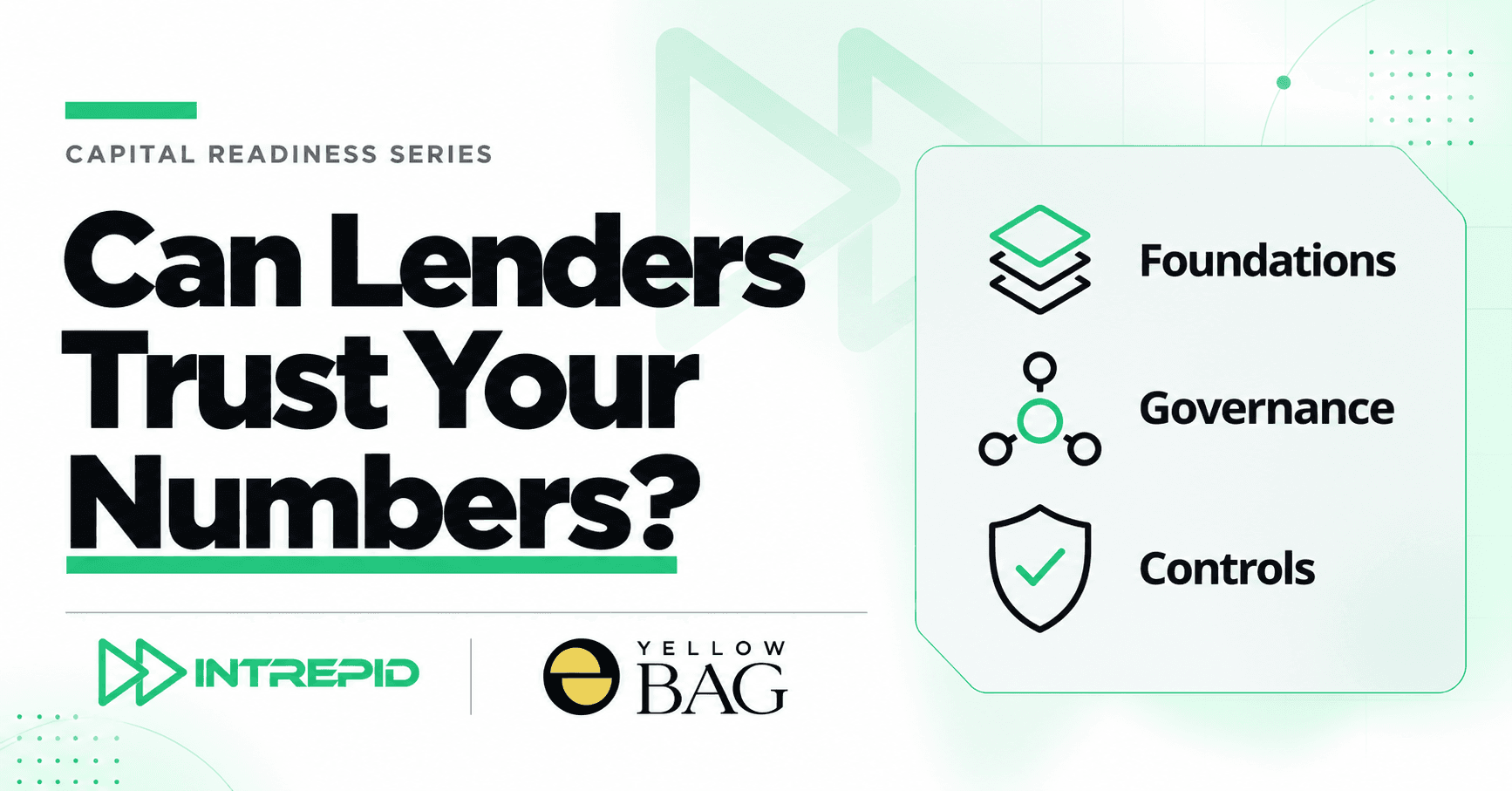
- Credibility is developed through three operating disciplines, Foundations, Governance, and Controls, well before statements are assembled for an application.
- A three-question checklist and five practical steps below help finance leaders assess where they stand.
In this article
What Is Financial Credibility?
Financial credibility is the organizational capability to consistently produce, explain, and stand behind financial information that reflects the realities of the business. It extends beyond statements that reconcile. It reflects whether leadership can substantiate the numbers when a lender asks how they were produced.
From the lender’s perspective, credibility is the first question rather than the last. Before revenue, growth, or collateral can be evaluated with confidence, an underwriter must determine whether the financial information itself can be trusted.
Financial credibility therefore can function as a gate. Every other element of the funding conversation depends on it, which is why it is the first pillar of the Capital Readiness Framework.
What Makes Financial Data Credible to an Underwriter?
Financial data lenders trust shares three qualities: it is consistent, it is current, and it reconciles to supporting records.
- Consistency. Revenue on the income statement aligns with bank deposits, and the debt schedule agrees with the balance sheet.
- Timeliness. Statements reflect the current condition of the business rather than a period several months past.
- Reconcilability. Balances can be traced to supporting records without repeated adjustments or unexplained variances.
When any of these qualities is missing, each gap becomes an underwriting question, and each question extends the evaluation. Lenders also weigh information differently. The FDIC’s 2024 Small Business Lending Survey found that smaller banks rely more on relationship-based information, while larger banks place greater weight on quantitative data, particularly for smaller loans. In either case, the underlying financial information has to hold up.
Connected financial data changes this dynamic. When an underwriter can review information drawn directly from source systems, in a structured and consistent format, the evaluation can focus on fit and structure rather than verification. This is the work Intrepid performs, turning real-time financial data into structured underwriting insights for lenders and brokers.
Why Do Financial Credibility Problems Start Before the Loan Application?
Financial credibility problems begin in the systems behind the numbers, long before a financing application is prepared.
How long does it take an organization to produce a balance sheet, profit and loss statement, or statement of cash flows?
While timeliness matters, a more revealing consideration is what the organization must do to produce those statements. The reconciliations performed, adjustments required, resources involved, and time spent investigating discrepancies reveal something the finished financial statements cannot fully convey.
Financial statements tell the story of business performance. The processes required to produce them tell another story: one of organizational credibility and maturity.
Two organizations may produce comparable financial statements through vastly different means. One relies on established, repeatable processes that consistently generate reliable information. The other requires extensive intervention to reconstruct operational activity before the reported results can be substantiated.
For lenders evaluating historical performance, repayment capacity, and forward-looking projections, the distinction is consequential. Underwriting does not ordinarily include a formal examination of an organization’s operational foundations, governance, or controls. Even so, the effectiveness of those disciplines becomes observable through reporting timeliness, supporting documentation, reconciliations, and management’s ability to explain financial performance.
Financial credibility, therefore, is not established when statements are assembled for a financing application. It is developed through the policies, processes, information, and organizational disciplines that determine how reliably the business operates.
This relationship is central to Yellow Bag’s Foundations, Governance & Controls (FCG) framework, which establishes the fundamental operating conditions necessary for enterprise technology and financial information to function reliably.
What Does Unreliable Financial Reporting Cost a Business?
Unreliable financial reporting costs a business twice: first in operational effort and visibility, and again during financing, when it slows underwriting and weakens confidence.
When operational transactions and financial records are not consistently aligned, the consequences extend beyond inefficiency in the accounting function.
Consider inventory leaving a distribution facility without corresponding system transactions. The discrepancies may require recurring adjustments to inventory balances, potentially affecting valuation, cost recognition, and margin analysis. Similarly, inconsistent order-entry practices can create downstream reconciliation requirements and uncertainty surrounding reported revenue.
Even when accounting ultimately reconciles the financial statements, the underlying operating deficiencies may persist. Financial teams become increasingly responsible for reconstructing the consequences of business activity rather than validating the results of established processes.
Weak governance and insufficient controls can compound these conditions. Pricing and discount practices that vary without appropriate oversight may compromise margin predictability, while unauthorized changes to transactions or configurations can undermine confidence in the information being reported.
The cost includes additional administrative effort, delayed financial visibility, and diminished confidence in the information supporting management decisions.
During financing, these conditions can introduce further complications. Inconsistent supporting schedules, unexplained financial variances, and difficulties substantiating projections may require additional underwriting inquiries and documentation, potentially extending the evaluation process.
The financing environment rewards preparation. In the Federal Reserve’s 2026 Report on Employer Firms, 42% of small business applicants received the full amount of financing they sought, and firms that chose not to apply because they expected to be declined most often cited weak business financials. The FDIC’s 2024 Small Business Lending Survey found that three in four banks approve their typical small business loan within 10 business days, a pace that is easiest to meet when financial information is ready to review.
The concern is not simply whether management can ultimately produce accurate statements. It is whether the organization can produce and substantiate reliable financial information consistently, without disproportionate corrective effort.
What Does It Take to Build Lender-Ready Financials?
Lender-ready financials depend on three distinct but interdependent operational disciplines: Foundations, Governance, and Controls.
These are not advanced enterprise technology capabilities or transformation objectives. They are baseline requirements for responsible business operations and financial management.
Foundations: Establishing Operational and Financial Integrity
A sound foundation consists of established policies, reliable data, and consistently executed core business processes. Transactions originating across sales, purchasing, inventory, fulfillment, and accounting must preserve the relationship between operational activity and its financial consequences.
This operational and financial congruence enables repeatable reconciliations, timely reporting, and dependable information about business performance.
Governance: Sustaining Accountability and Alignment
Governance preserves the integrity of those processes as business requirements evolve. Clearly defined ownership, decision authority, coordinated change management, and appropriate communication ensure that changes are evaluated, authorized, and coordinated with consideration for their effects across interconnected functions.
The objective extends beyond managing technology configurations. It is to maintain accountability for how the business operates and whether established processes continue to produce their intended outcomes.
Controls: Protecting Transactions and Information
Controls provide the preventive and detective safeguards necessary to protect business processes, transactions, systems, and financial information.
Segregation of duties, approval requirements, access restrictions, transaction validations, reconciliations, and exception monitoring help prevent unauthorized activity, identify errors, and establish reasonable assurance that established processes are operating as intended.
Together, these disciplines enable management to rely on financial information without repeatedly reconstructing the business activity behind it.
More sophisticated capabilities can build on those foundations, but they cannot reliably compensate for their absence.
What Each Discipline Looks Like to a Lender
| Discipline | What Yellow Bag Builds | What a Lender Sees |
|---|---|---|
| Foundations | Reliable data, codified policies, and consistent processes that get operational and financial information in the right shape. | Timely, reconcilable financial statements and dependable operational information. |
| Governance | Clear accountability and oversight through management structures, documented processes, and standardized alignment. | Management credibility, consistency in performance, and supportable projections. |
| Controls | Disciplines and safeguards that protect financial records, processes, and data across the organization. | Confidence in reported balances, supported documentation, and financial risk management. |
The underwriting perspective reflects potential indicators observed during credit evaluation rather than a formal assessment of the FCG framework.
How Can Finance Leaders Strengthen Financial Credibility Before Seeking Capital?
Finance leaders can strengthen financial credibility by assessing each discipline candidly, addressing the gaps that most affect reporting, and preparing well ahead of a funding conversation.
Financial Credibility Checklist: Three Questions for Finance Leaders
As leadership establishes the groundwork for financial credibility, visibility, and organizational maturity, three questions warrant consideration:
- Foundations: Are our policies, data, and core processes sufficiently reliable to ensure financial reporting accurately reflects the business?
- Governance: Is there clear accountability for maintaining operational alignment, including how changes are evaluated, authorized, coordinated, and communicated?
- Controls: Are the safeguards protecting our transactions, systems, processes, and financial information appropriately established and functioning effectively?
Five Practical Steps Before Your Next Funding Conversation
- Measure your close. Track how long it takes to produce monthly statements and where adjustments and delays occur. The answer reveals where processes depend on intervention.
- Reconcile operations to accounting. Confirm that inventory, order, and billing activity in operational systems ties to the general ledger each period.
- Assign ownership for change. Define who authorizes changes to pricing, system configurations, and core processes, and how those changes are communicated.
- Review your controls. Confirm that segregation of duties, approval requirements, and access permissions reflect how the business operates today.
- Prepare the lender package early. Assemble current financial statements, a debt schedule, and supporting schedules before a lender asks, so leadership can explain variances with confidence.
Each step strengthens the connection between underwriting and financial reporting before an application is ever submitted.
Why Is Financial Credibility an Organizational Capability?
The combined value of foundations, governance, and controls extends beyond historical reporting into financial planning and management’s ability to substantiate future performance.
Credible revenue projections depend on the organization’s capacity to execute anticipated demand. Margin forecasts require disciplined pricing, purchasing, and cost management. Cash-flow projections depend on reliable visibility into inventory, receivables, payables, and the timing of underlying transactions.
These relationships allow leadership to connect expected financial performance to the operating capabilities necessary to achieve it. For companies pursuing capital, that capability provides a stronger basis for demonstrating historical performance, substantiating projections, and supporting confidence throughout the lending process.
Financial credibility is not simply the ability to produce statements that reconcile. It is the organizational capability to consistently produce, explain, and stand behind financial information that reflects the realities of the business.
How Do Yellow Bag and Intrepid Work Together?
Yellow Bag and Intrepid address two sides of the same challenge. Yellow Bag strengthens the operating disciplines that produce reliable financial information. Intrepid helps lenders and brokers evaluate that information with speed and consistency.
Yellow Bag’s Foundations, Governance & Controls framework helps organizations establish the policies, data, processes, and safeguards that keep operational activity and financial records aligned. The result is financial information leadership can explain and stand behind.
Intrepid’s platform turns real-time financial data into structured underwriting insights and intelligent lender matching, automating document collection, bank statement and financial analysis, and covenant testing so lenders and brokers see a clear, consistent picture of the business.
“Lenders rarely examine an organization’s processes directly, yet they experience the results of those processes in every document they review. Credibility is built in operations long before it is tested in underwriting.” Larecha Wynn, Founder and CEO, Yellow Bag
“Every deal that hits underwriting tells us something about the business behind it. When the numbers are clean and connected, the conversation moves to fit and structure fast. That changes who gets funded.” Steve Iskander, Founder and CEO, Intrepid Finance

Main Takeaway
Lenders evaluate more than financial statements. They evaluate whether an organization can consistently produce, explain, and support them. Businesses that invest in foundations, governance, and controls before seeking capital give underwriters a clearer picture, fewer reasons to pause, and a stronger basis for confidence.
Take the Next Step
For business owners and finance leaders: Talk with Yellow Bag about strengthening the foundations, governance, and controls behind your financial reporting. yellowbag.tech.
For brokers and lenders: Visit intrepidfinance.io to see how Intrepid turns real-time financial data into structured underwriting insights and intelligent lender matching.
Frequently Asked Questions
How do lenders decide whether to trust a company’s financial statements?
Lenders decide by checking whether the numbers are consistent across documents, current, and supported by records that reconcile. For example, an underwriter gains confidence when reported revenue aligns with bank deposits and leadership can explain a change in margins without delay. Gaps between sources usually lead to additional questions and documentation requests.
What are lender-ready financials?
Lender-ready financials are current, reconciled statements that a business can provide as soon as a lender asks, along with the supporting schedules behind them. That typically includes a recent balance sheet, profit and loss statement, cash flow statement, and debt schedule that agree with each other and with bank records.
What is the difference between financial performance and financial credibility?
Financial performance describes what the numbers show, while financial credibility describes whether a lender can rely on them. For example, two companies with similar revenue growth can have very different underwriting experiences if one produces statements through repeatable processes and the other relies on manual reconstruction and adjustments.
Does an ERP system make financial statements credible?
No, not on its own. An ERP system supports financial credibility only when the policies, data, processes, governance, and controls around it are sound. For example, inventory that leaves a warehouse without a corresponding system transaction creates the same reconciliation problem in any software.
When should a business start preparing its financials for a loan?
A business should start well before a financing need arises, because the disciplines that make statements credible take time to establish. A practical first step is to review recent monthly statements for timeliness, recurring adjustments, and unexplained variances, then address those gaps before approaching a lender.
What is the Foundations, Governance, and Controls framework?
The Foundations, Governance, and Controls framework is Yellow Bag’s model for the three operating disciplines behind reliable financial reporting. Foundations cover policies, data, and core processes. Governance sustains accountability as the business changes. Controls provide the safeguards, such as approval requirements and segregation of duties, that prevent and detect errors.
About the Authors
Steve Iskander
Steve is the Founder and CEO of Intrepid, where he is building AI driven infrastructure to modernize credit assessment, lending management, and capital access. A serial entrepreneur with more than 15 years of executive leadership across finance, private equity, and technology, Steve has founded and scaled multiple companies, including successful exits in tech. His work focuses on democratizing access to capital, automating regulatory and underwriting workflows, and partnering with institutional financial leaders to build the next generation of data driven fintech platforms.
Larecha Wynn
Larecha is the Founder and CEO of Yellow Bag, an independent enterprise technology advisory and implementation assurance firm serving CFOs and executive leadership teams. With experience leading more than 40 global ERP system projects, she helps organizations align business strategy, operations, and enterprise technology to achieve intended financial and operational outcomes.
Her work spans technology planning, implementation oversight, and post-implementation performance, with an emphasis on organizational readiness, accountability, and protecting technology investments. Through Yellow Bag’s Foundations, Governance & Controls framework, she advocates for the operating disciplines necessary to produce reliable financial information, strengthen decision-making, and support sustainable growth.
About Intrepid
Intrepid Finance is a fintech financial intelligence company building the technology rails for modern commercial funding. Its platform turns real-time financial data into structured underwriting insights and intelligent lender matching for commercial loan brokers, private credit funds, institutional and community banks, and alternative lenders.
Learn more at intrepidfinance.io.
About Yellow Bag
Yellow Bag is an independent enterprise technology advisory and implementation assurance firm helping CFOs and executive leaders protect technology investments and achieve meaningful business outcomes. Serving growth-stage and mid-market product-based companies across manufacturing, distribution, and consumer goods, Yellow Bag provides strategic guidance, organizational readiness, and independent oversight before, during, and after major technology initiatives. Its approach aligns business strategy, people, processes, information, and technology to reduce risk, strengthen execution, and accelerate time to value.
Learn more at yellowbag.tech.